Showing posts with label Help Desk. Show all posts

Monday, December 30, 2013

Three-tier Customer Support – the right perspective

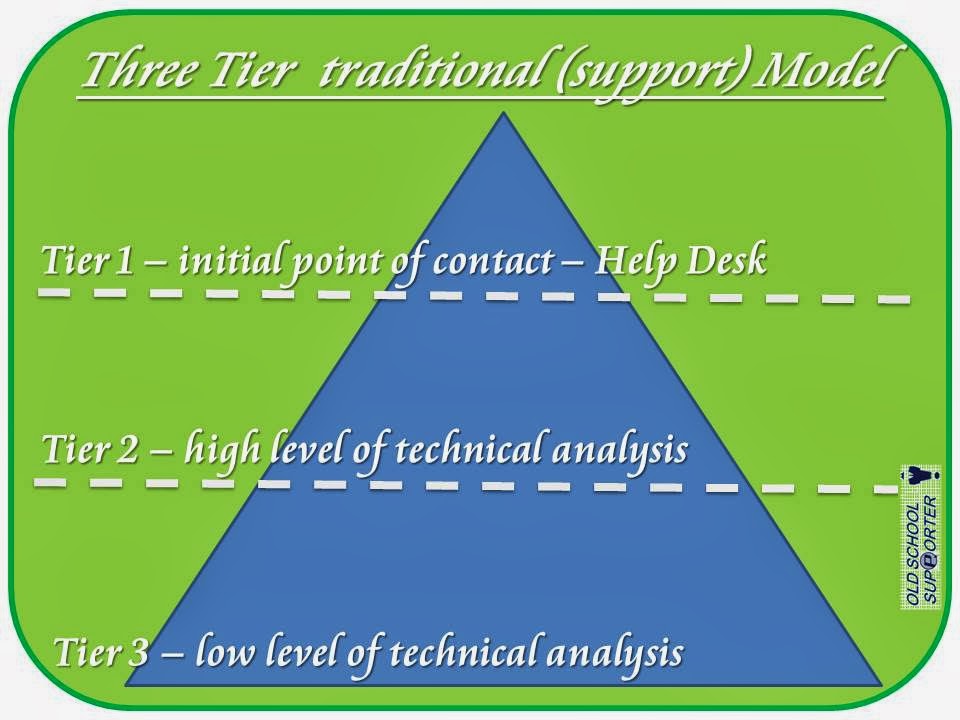
This schematic diagram of three-tier Customer support shows the various tiers relate the customer. Usually Customer Support is integrated throughout the entire organization. Well-managed interaction between the Helpdesk (Tier 1), TAC (Tier 2), and Escalation (Tier 3) provides support targeted to user needs.
It is often illustrated as a triangle, where its head illustrates Tier-1 of support, the initial point of contact for the customer. Each level of escalation is wider, as tier-2 and Tier-3 are normally have much more expertise to focus on.
In my perspective, I’m seeing an “upside down’ triangle, where its base is the Tier-1 and head’s is Tier-3.

The reason, regardless the type of support you provide, the lower the (tier) level of support, their knowledge, in high level covers (should be) all product’s aspects while the higher the (tier) level goes, they are focused in vary narrow aspects of the product.

Confused? Don’t be…

Tier-1 needs to have high-level of knowledge with product’s current feature set as well as the roadmap. Basic troubleshooting skills for the product as well as its eco-system (i.e. if I’m supporting a server, I need to know to troubleshoot the client as well as the network in between). The HelpDesk representative, need to determine if the problem is with a creation sub system or another, so when they will escalate it, it will reach the relevant TAC team.

Tier-2, aka TAC, focuses on part of the system, with more knowledge, they can “dive” into lower level of that system/service for troubleshoot and fix.

Tier-3 – R&D like team focuses a specific server or service to provide resolution for a problem.

See the differences?  The wider the base is, the vast knowledge the helpdesk has will make your support organization stable and efficient.

Less escalation means  that cases are being closed faster and efficient.


Wednesday, March 13, 2013

Apology to the customer. Is it necessary?

I have read this blog post advising some essential beliefs [Kate Nassers (the author) point of view] to deliver a “Super Customer Service Experience” [here]. I can agree with most of the list, with some less.

There is this statement:

“A sincere apology is the quickest way to repave the road of customer trust”


I know that in most cases it works, but why one need to be there in the first place? Pay attention to the customer complaint. Listen! Don’t hear! , see my post “It is all about listening [here].

Empathic listening is the way the supporter needs to listen respond to the customer’s complaint for mutual understanding and trust. Once the problem was understood you can start handle the case.

When case is being escalated to the next level of support, there is no need to apology as well; you can use a statement that will soften the customer, i.e “your case was escalated to me for investigation. I have read the case and I can see that….”

Apology will be used as “doomsday weapon” when you don’t have any solution for the problem.

Friday, March 8, 2013

Embedded Customer

The phrase “customer experience” is used often when describing customer’s feedback. Studies show us that creating “wow” experiences and “please” customers doesn’t often improve the experience, especially if the was one time interaction. It didn’t increased customer loyalty once thought. Moreover, customer becomes more and more powerful.

Company’s focus (not just the support organization) started changing from a complete organizational view to a customer-centric view. An organization that foresees the future are in a process to be fully connected to "embedded" customer.

The "embedded customer" main principle is to to engage the customers in decisions taken by the company. One can see it as a seat in an advisory board of the company. However, companies must keep their balance as they face the challenge not to become too friendly with the “advising” customer. It should only be involved customers who have a genuine interest in the development of the company.

Tuesday, February 26, 2013

Zendesk CRM benchmark kickoff

As I have mentioned Confucius in one of the first posts [here], it was quite obvious that I will select “Zendesk” CRM [www.zendesk.com] as my first test case.


I have started googling the for “why using zendesk” and noticed that at the first 6(!) pages all results were linked to Zendesk’s web site. All accept two: a 3 years old “Hacker news” bad comment that “ZenDesk don't love their users“ [here] and “Planbox” advising why should one use this application [here].

With those two conflicting posts I have decided to test this cloud based service, think of it as SaaS.
So I have created myself a 30 days trial account to test it myself, hoping that this time period will be enough to asses it. 

Test results will be posted in the CRM benchmarking page [here]

Tuesday, February 19, 2013

Looking for the best CRM ever

CRM stands for "Customer Relationship Management" and among other things it is used to track customer's "Trouble Tickets" aka "cases".
Back at the 90s i was responsible for the network of some dozen remote branches sites, to follow the active cases  I have used the good old whiteboard with some markers, various colors to define severity. Later on I have digitized it into excel and MS Access.


Later on, when started to work for service provider, the impotency of having the support and sales info consolidated ion one platform was implanted into my own perspective. In my early days of supporter, for internal customers I was focused for finding the best "Trouble Tickets" management system, now after two decades and working with numerous solutions like Siebel  (ver 3.0 if I recall), Vantive  (in its original form), Oracle, Microsoft and SalesForce I can say that support and sales linkage is a must. 
For example, validating the existence of support contract, as no one want to work for nothing. Asking for renewal when required, advising for upgrade when needed. Like the supports, so do the salesperson, he/she can learn the customer's history when preparing for a meeting.

As benchmarking and reporting the big sharks in this market is not fun, so I plan to check out some of the small players in this market of CRM applications. My reports will be summarized in a separate page that I have named CRM benchmarking  

Wednesday, February 6, 2013

What is good customer service

There isn't any right answer, or a wrong one.  In my perspective it is not about how fast the case is closed, it is about the quality of the service. For example, I'm having hard time setting my brand new mobile to send MMS. Calling in to the helpdesk, in most cases they will advise to check the tutorial on the web, either in their web site or manufacturer's. Those are the ones that are just doing their job.

Those with good customer service are the ones that tell you, and guide through the process. "Select the settings tab, then select network..." Or, "Mike! This Guy on the phone have issue with settings, I'm not familiar with mobile. Can you advise? Thanks." That's good customer service! 

Problem solving thumb A need to know basis and problem solving skills…

Based on the first contact the customer will have, their satisfaction and expectation for their next interactions will be set.
Here are some rules of thumb to improve your support and make it excellent customer service. It will keep people coming back to you (for the right reasons)… 
·         Make sure you represent a product or service you believe in!
·         Warm & sincere greeting on first contact.
·         Establish whether your business has what the customer needs (offer to help find it)-provide it or suggest better alternative, to their benefit.
·         Develop an easy and positive intimacy with the customer. Let them know they are respected and appreciated.
·         Go above and beyond. Then, provide an easy, efficient solution.
·         Sincerely and warmly thank the customer for their business and invite them to come back if ever they need your help again.

Image source My Australian Secretary  

Thursday, January 17, 2013

The fine line between integrity and honesty


In previous post I have advised that "Professional Integrity" refers to code of conduct that one should maintain putting the organization in mind. That behavior is expected from TAC or Helpdesk representative. What about a supporter that acting as "Account Manager", shouldn't he be honest and frank with the customer? 
This is exactly the fine line that one needs to maintain, being loyal both to the company as well as the customer. Like a trapeze juggler in the circus.


Keeping this fine line and being diplomatic when providing RCA (Root Cause analyses) to the customer, do not exaggerate. Be specific as possible to the case, provide facts, and advise action items that were taken.
I have hared of a case where malfunction in certain device caused an outage in customer's network. As R&D didn't had any clue what was the reason. A senior support manager decided to take care of it and provide an RCA.

"Dear Customer,
We have found out that Mr X, one of our engineers was logged in to you network and caused this outage. Please be advise that Mr X is no longer working with us.

Sincerely, Sorry..etc'..."

Mr X. had left the company two weeks before that event. He was the supporter that logged the initial customer complaint.


Image source Zap! Entertainment

Wednesday, January 16, 2013

TAC & HelpDesk Professional Integrity


Confucius once said that "the strength of a nation derives from the integrity of the home". As we are dealing here with the customer supporter role in an organization I'll fine tune this statement: The strength of a support organization drives from the integrity of its employees. 


When business is involved, the word integrity, in most cases will be accompanied with the word professional. The words professional integrity used in order to describe the manner that one (or many) should act in an organization. Asking around (actually googeling...), professional integrity is all about making the right choices in regards to the good of the company. It manes that one should act ethically and loyally to the place he works for.
Now, it doesn't say that one, in the name of inegrety should run and tell the customer that the developer mistakenly deleted important formula in the code that caused the damn box to reboot by itself. Don't mix integrity with honesty. Spencer Johnson explained it pretty well:

Integrity is telling myself the truth. And honesty is telling the truth to other people. 

Confused?
Professional integrity is about making decisions as to what is right to the company; instead of what will make me look better when facing the customer.

Using the developer mentioned as example, the one that mistakenly deleted part of the code, this is the truth, but what should I advise the customer? Should I be honest and tell the truth? 
In this case, I'll wear my rose-colored glasses and update the customer that a file was corrupted, perhaps when it was downloaded / uploaded /emailed etc'. 

Honesty is not always the best policy, In the organization perspective of course, so in this case I will advised the customer that the issue was found, and it was related to configuration file, that it's integrity was compromised, and that we have fixed it.

The above is the general behavior that is expected from supporter that is part of HelpDesk or TAC, one that response, or better to say react to tens of service call and cases per day.
If you are an account manager, or support representative dedicated to support particular customer, the expected code of conduct is different.


Image source C. Harris